
- Posted on
- • Background
Data Science, AI and LLMs
- Author
-
-

- User
- maintainer
- Posts by this author
- Posts by this author
-

This is an attempt to classify the terms and definitions around data science, artificial intelligence (AI), generative AI (GenAI), large language models (LLM) and the different harness types used for GenAI and LLM:
| Term | Data Science (mathematical perspective) | Artificial Intelligence (perspective of use) |
|---|---|---|
| Science Discipline and Target | Is primarily about the collection, classification, aggregation, description, interpretation, simulation, and prediction of data | Is primarily about building and simulation of intelligent behavior |
| Data Mining | Statistical and other algorithms for learning and prediction based on historical data | Machines identify and derive relationships from data |
| Machine Learning | Computer algorithms based on neural networks for learning and prediction based on historical data | Machines independently derive relationships from large amounts of data |
| Deep Learning | Computer algorithms based on deep neural networks for learning and prediction based on historical data | Machines independently derive relationships from vast amounts of data |
| Generative AI | Deep neural networks for generating new data, for example based on the Transformer architecture or Generative Adversarial Networks (GAN) | Intelligent answering machine (with reasoning capabilities) |
| Artificial general intelligence (AGI) | Logical prompt interpretation, abstract reasoning and abstract knowledge | generally usable AI |
| Artificial superhuman intelligence (ASI) | Self generated and self improved prompting, reasoning and knowledge | self learning and self improving AI |
Now let us build on this two perspectives, the mathematical perspective and the (algorithmic) perspective of use and introduce the term harness (approximately ordering them by complexity from simpler to more advanced):
| Complexity Order | Model Types (mathematical perspective) | Harness types (algorithmic perspective of use) |
|---|---|---|
| 1. | GAN = generative adversarial networks for data or image generation | single input / single prompt = model context is reset after each single input or prompt |
| 2. | Transformer = neural networks with (multiple head) attention layers (usually used for language models) | chat = each user prompt and reply in a session is added to model context |
| 3. | SLM = small language model (with millions or few billions model parameters) | Context enrichment with RAG, HyDE, MCP or Websearch = Chat where each user prompt is supplemented with a result of a search for related information (based on his prompt) |
| 4. | LLM = large language model (with more than few billions parameters) | Reasoning = Chat where each user prompt is supplemented with an additional system prompt and a logical loop for solving the request in steps along with a definition, when the systems internal chat has to finish and return to the user chat session |
| 5. | MoE = muxture of experts (activation of specialized sub neural networks, called experts) | Autonomous assistants = a reasoning chat system with a capability to read and write artifacts within a predefined environment, such as files within a specific folder |
| 6. | MLLM or LMM = multimodal large language model or large multimodal model (where input or output can be carried out in different media types, such as text, audio, video etc.) | Tool calling capabilities = This term is usually used, when an autonomous assistant has more than one tool calling option and capability |
| 7. | MLLM with MoE architecture | Agent swarm = Multiple coordinated assistants = This term is used when one master assistant can delegate sub-tasks to other assistants, where starting and prompting an assistant is one of the capabilities of the master assistant |
As you easily can see, the complexity order of model types and harness types are independent from each other. So why to put them beside each other? The reason is, that there is some correlation: more complex harness types use more complex models. And on both sides, the next level of complexity builds on top of the features and capabilities of the previous one.
See also:
What are the different RAG methods to minimize AI confabulation
Is sandboxing sufficient to contain rogue agents
The information security perspective --> AI alignment isn’t really the problem here: labs just need better infrastructure.
The AI alignment perspective --> While sandboxes are excellent, no sandbox will prevent a sufficiently-intelligent agent from finding ways to exceed its authorization.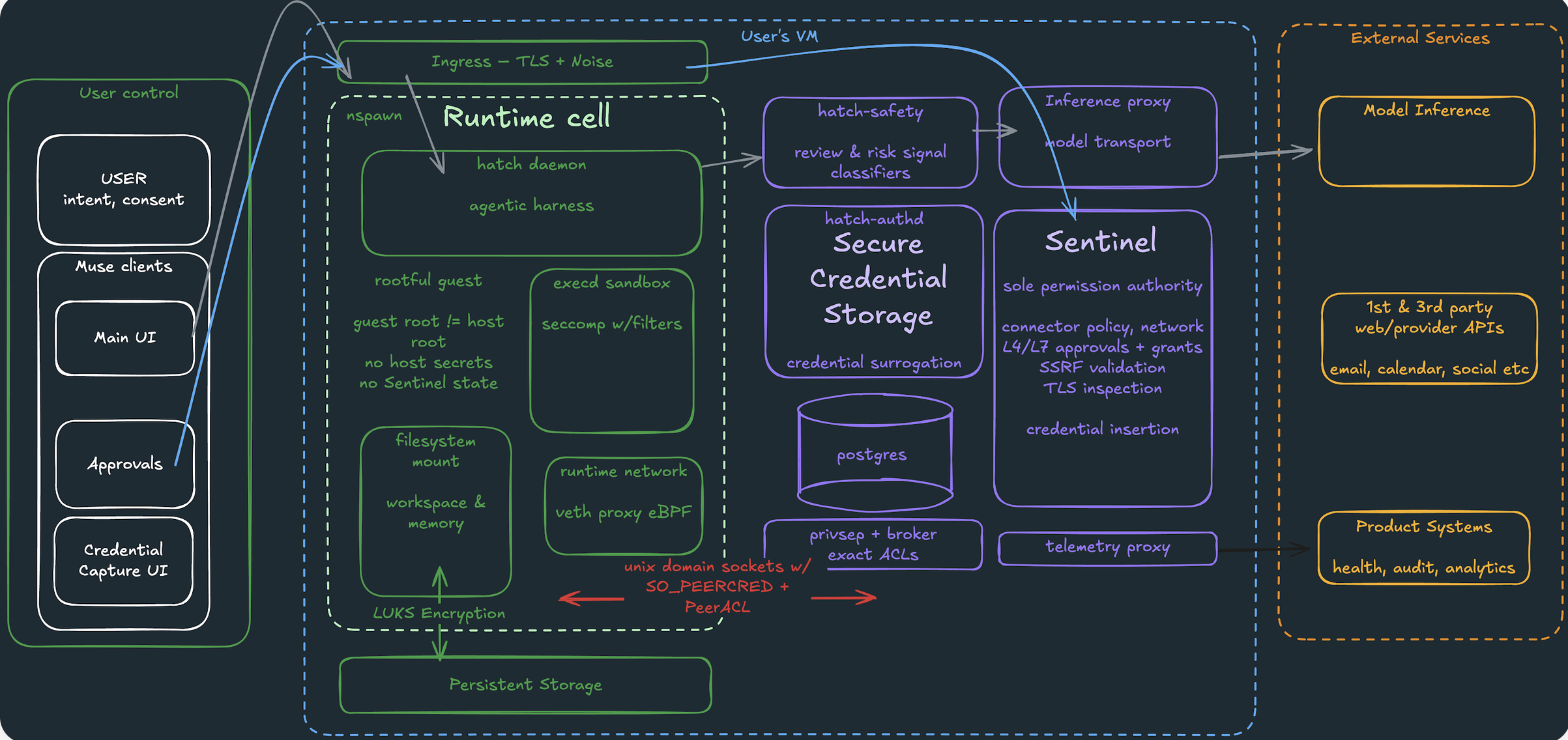
Have fun 😉